

Renal disease is an extremely common and serious complication of diabetes mellitus. We studied 263 urine specimens from Veterans seeking care at a Veterans Affairs Healthcare Center Nephrology Clinic. Samples were collected from patients that had kidney biopsies as part of their care and also from non-biopsied diabetic and non-diabetic CKD patients, and healthy volunteers. All urine samples were analyzed with UMF procedures and technology. (Kavuru, V, Senger, RS, Robertson, JL, et al)
There were several important findings.
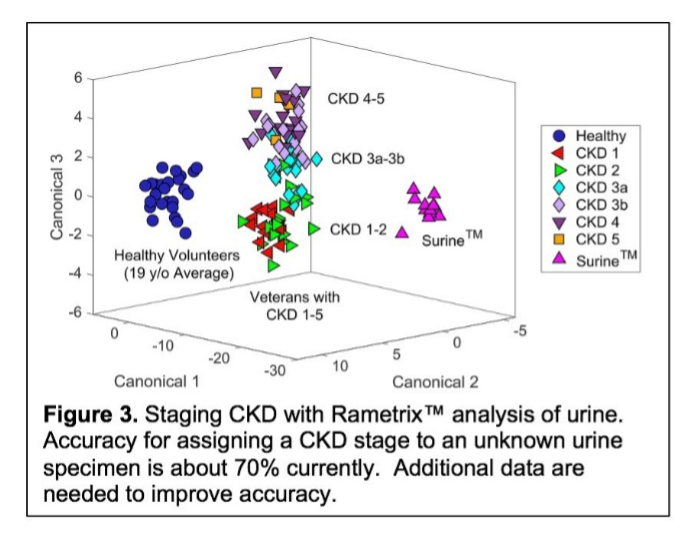
First (figure left), the stage of CKD, determined with eGFR (using serum creatinine measurement), could also be determined directly from urine – using UMF.
Second, urine samples of diabetic kidney disease (DKD) patients and those with immune-mediated nephropathy (IMN) were distinguished from one another with 82% sensitivity, specificity, positive-predictive value (PPV), and negative-predictive value (NPV). In effect, urine was an effective surrogate metric (a liquid biopsy) of kidney pathology.
This was also seen with another kidney pathology. Among urine samples from all biopsied CKD patients, membranous nephropathy was identified with 66.7% sensitivity, 96.4% specificity, 80.0% PPV, and 93.1% NPV.
UMF may be able to differentiate between DKD, IMN, and other glomerular diseases. Future work will further characterize CKD stages and glomerular pathology, while assessing and controlling for differences in factors such as comorbidities, disease severity, and other lab parameters.
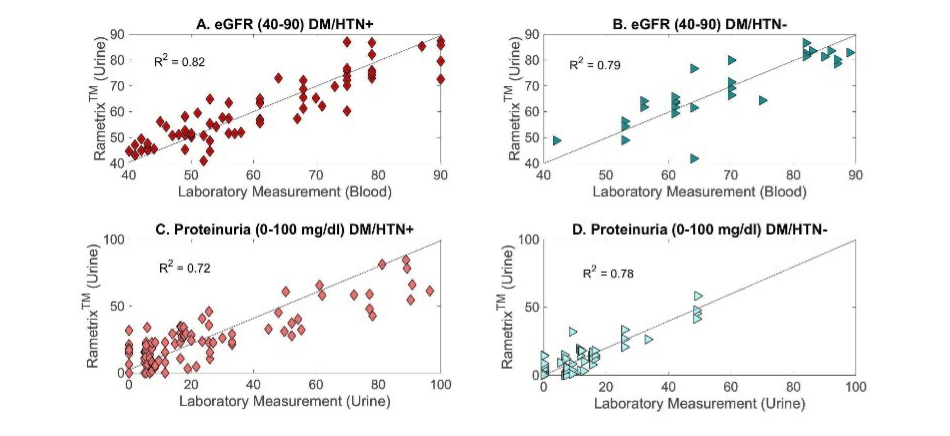
Finally, we showed a very strong correlation between traditional ‘Gold Standard’ methods of determining renal function (eGFR) and also levels of urinary protein determined with nephelometry (figure left). Once again, UMF may be a useful and effective surrogate metric for assessing renal function – differing from current methods.