
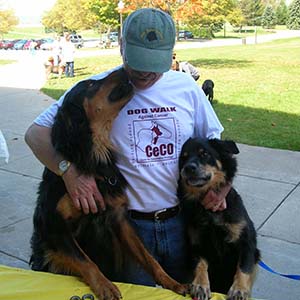
Several breeds of dogs, including Bernese Mountain Dogs, Golden Retrievers, German Shepherd Dogs, and short-legged terriers (West Highland White Terriers, Scottish Terriers) have a significantly higher incidence of specific cancers than other breeds of dogs. For example, up to 50% of Bernese Mountain Dogs may develop aggressive soft tissue tumors (sarcomas) or lymphoma, and up to 50% of Golden Retrievers may develop lymphoma or tumors of the spleen/heart (hemangiosarcoma). In many cases, these cancers are not detected until a ‘lump’ or swelling is noticed, along with more non-specific signs (loss of appetite, weight loss, lameness, among others). Treatment of dogs with these tumors is challenging and costly and outcomes of treatment are problematic.
People also get these types of tumors but much less frequently than dogs. Sadly, treatment can also be challenging, debilitating, and costly, but with more predictable and better outcomes than dogs.
Regardless of the species (two-legged or four-legged), winning the battle against cancer involves accurate diagnosis and effective individualized treatment. And…the earlier cancer is detected, more likely it can be controlled, put into long-term remission, or even….cured.
Rametrix Technologies Inc. has launched a multi-year program to improve cancer detection and outcomes for dogs and for people – using knowledge gained from both species (dogs and people!) – in the fight against cancer.


Working with the sponsorship of the Berner Garde Foundation, Bernese Mountain Dog Club of America, and Westie Foundation of America RTI has built a Urine Molecular Fingerprinting spectral database of samples from hundreds of clinically dogs (“Berners”). In the next phase of this project (2026-7), urine samples from Berners with cancer will be analyzed and “fingerprints” of specific types of cancer (especially aggressive soft tissue sarcomas) will be determined – through comparison of patient samples with the large collection of samples of healthy dogs in the database. These “cancer-type specific fingerprints” will then be used for monitoring whether treatment is helping Berners under therapy and to see if they are present in dogs before they develop cancer (early detection).